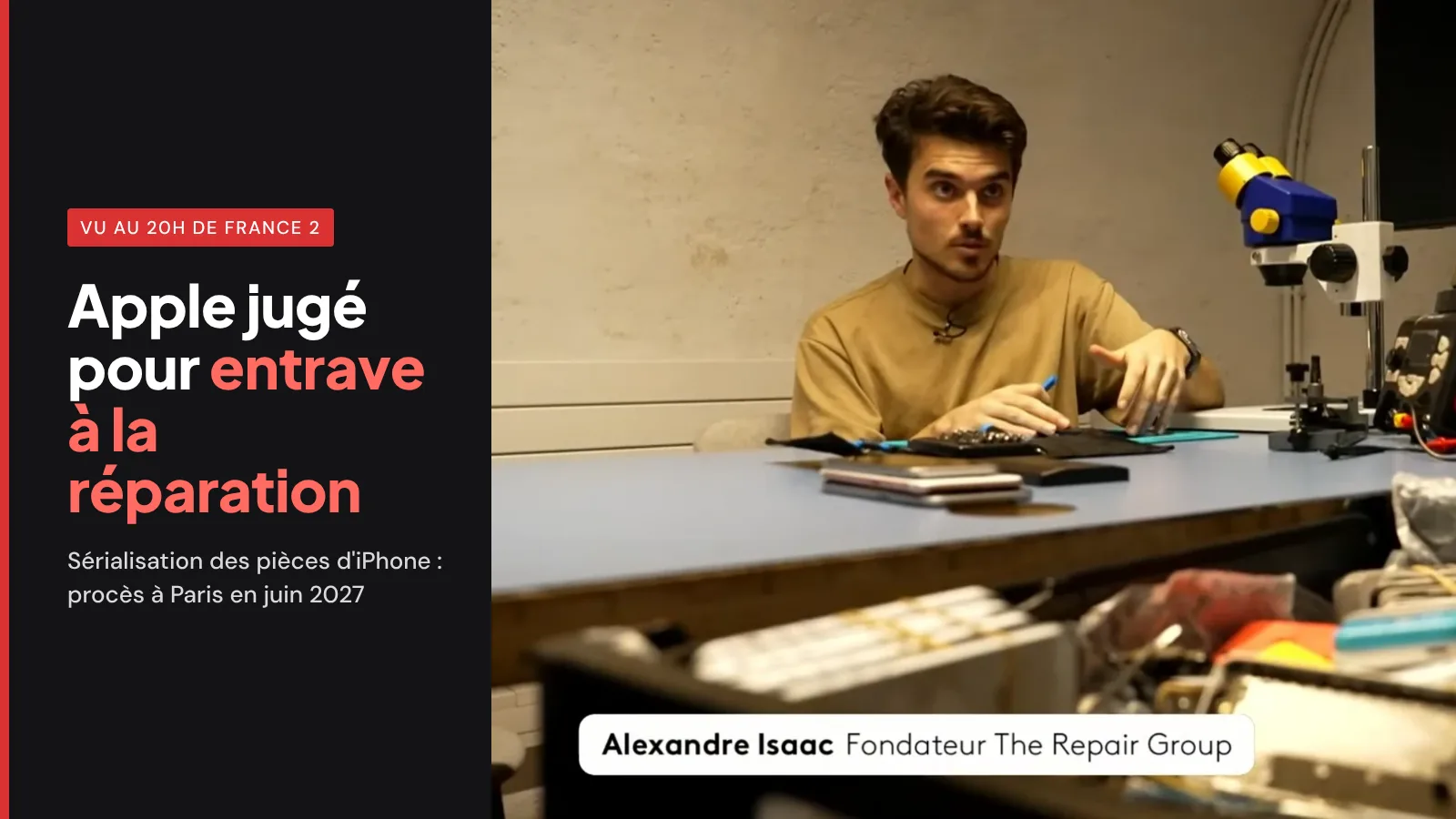
Apple will stand trial in June 2027 before the Paris criminal court for planned obsolescence by obstructing repair, following a complaint filed by the French nonprofit HOP in December 2022. On November 17, 2026, the evening news on France 2, the French public TV channel, covered the case and interviewed Alexandre Isaac, founder of The Repair Academy and The Repair Group. Here is what the case says, what we explained on air, and five years of work on parts pairing.
What Apple is accused of
HOP (Halte à l'obsolescence programmée) announced on November 17, 2026 that Apple had been referred to the Paris criminal court. The facts cover 2021 to 2024: the company is accused of limiting some iPhone functions when a part was replaced by a repairer outside its authorized network. According to HOP, this is the first time French prosecutors have relied on the offense of obstructing repair and refurbishment.
That offense comes from France's 2020 anti-waste law (known as AGEC), strengthened in 2021: article L. 441-3 of the French Consumer Code bans any technique, including software, by which a manufacturer makes it impossible to repair or refurbish a device outside its authorized channels.
Apple firmly denies the allegations, which it calls unfounded, and points to the durability of its products and its software updates. A scheduling hearing is set for February 25, 2027, and the case will be heard in June 2027 (franceinfo, November 17, 2026, in French). Like any defendant, Apple is presumed innocent until a verdict.
Parts pairing, explained by a repair tech
Parts pairing, also called serialization, ties a part to the serial number of the device. Screen, battery, camera, Face ID sensor: each part carries an identifier that the logic board checks at boot. If the identifier does not match, the iPhone shows an "unknown part" type of warning or turns off a feature. The real issue is this: it also happens with a genuine part taken from another identical iPhone. Part quality is therefore not the only criterion.
That is what Alexandre Isaac summed up for France 2: repairing an Apple product means planning for a software step, checking part compatibility and sometimes having to buy parts from the manufacturer, while on other brands, manufacturer, aftermarket or used parts can be fitted without that step. The report is available on franceinfo and in the replay of the evening news (at 16:03), both in French.
For an independent shop, working around pairing is still possible in some cases: you move a chip from the original part to the new one, or reprogram it. But that takes a microscope, a soldering station, training and time, so a cost the customer ends up paying, or a repair that never happens. If you are new to the technique, start with what micro-soldering is.
What we measured back in 2021
In 2021, The Repair Academy listed 23 components and peripherals commonly replaced on an iPhone, then counted, model by model, how many are paired. The French consumer group UFC-Que Choisir reported the data in April 2022:
| Model | Year | Share of paired parts |
|---|---|---|
| iPhone 7 and 8 | 2017 | over 20% |
| iPhone XR and XS | 2018 | 40% |
| iPhone 12 | 2020 | 45% |
At first, only the processor and the modem were paired. The battery followed with the iPhone XR, the screen with the iPhone 11, then the camera on the iPhone 12 and 13, along with most sensors.
Five years of work on the right to repair
- July 13, 2021. Webinar by the Right to Repair Europe coalition on part pairing, with Alexandre Isaac, Back Market and iFixit.
- 2021. The Repair Academy study of 23 iPhone components, whose chart was later published by iFixit.
- February 2022. Our tutorial on moving the screen chip on the iPhone 13 (in French), the first model where a simple screen swap disabled Face ID.
- April 28, 2022. UFC-Que Choisir publishes "iPhone: soon impossible to repair?" (in French), based on our data.
- December 2022. HOP files its complaint against Apple over parts pairing, a case on which we worked jointly with the nonprofit.
- January 17, 2023. iFixit publishes "How Parts Pairing Kills Independent Repair", with our data and Alexandre Isaac's input.
- May 2023. The Paris prosecutor's office opens an investigation (in French), handed to the French consumer fraud agency, the DGCCRF.
- July 5, 2023. Alexandre Isaac is the guest of the Fight to Repair podcast.
- 2024. Apple announces support for used genuine parts, then ships a repair assistant with iOS 18. The European Union adopts Directive 2024/1799 on the right to repair.
- November 17, 2026. Apple is referred to the Paris criminal court and France 2 covers the story on its evening news.
The role of HOP
This trial exists because one nonprofit kept the case alive for four years: HOP, with which The Repair Academy worked jointly on parts pairing. After its 2017 complaint over slowed-down iPhones, HOP had already obtained a 25 million euro settlement between Apple and the DGCCRF in 2020. Its 2022 complaint on parts pairing now leads to the first criminal hearing on obstruction of repair in France. The France 2 report notes that the nonprofit relied on research from specialized companies: that is exactly the part repair professionals can play, by documenting at the bench what users notice but cannot explain.
What it changes for repair shops
Apple has relaxed several rules since 2024, and HOP says those changes still have to hold over time. Whatever the outcome of the trial, the underlying trend stays the same: devices ship with more and more paired components, and repair happens more and more at the logic board and software level. That is why reprogramming paired components is part of what we teach in our micro-soldering and board repair program. A technician who masters these skills does not need anyone's permission to hand back a fully working device.