Board-level training
Smartphone Board Repair and Micro-Soldering
Diagnose and repair smartphone motherboards by micro-soldering. Two formats, one programme: 70 h in the workshop (2 weeks) or 35 h as a blended course (1 week in the workshop).
What you will be able to do
Four skills, from diagnosis to repair.
Diagnose from schematics
Identify the technical components and take measurements in line with the electronic schematics to diagnose a motherboard: short circuit, open line, start-up, charging, display, audio and network circuits.
Solder with dexterity
Use soldering equipment safely to repair motherboards, to a quality level equivalent to the manufacturer’s or to refurbishment standards, in compliance with ESD and HSE rules.
Replace and rework
SMD (0402 to 01005), BGA, NAND, FPC connectors, USB-C and Micro-USB, micrometric jumper wire repair, full reballing of a two-part motherboard, repair in the inner layers.
Master the software
Use 3uTools, Refox, XinZhiZao and schematic software, analyse restore errors, understand iTunes errors and document each intervention.
After the course
What the job of a repair technician involves.
- Rigorously follow a diagnostic procedure
- Detect a software, hardware or electrical fault
- Read and explain a block diagram
- Identify components on the board and on the schematics
- Interpret multimeter values to diagnose a fault
- Judge whether a board has a history: oxidation, overheating, bending, carbonisation
- Document an intervention: repair sheet, photos, measurement readings
The course
The reference course for repairing a smartphone motherboard.
This micro-soldering course lets smartphone repair professionals (6 months of experience minimum) become autonomous in advanced diagnosis and smartphone motherboard repair: reading schematics, multimeter measurements, short-circuit detection, replacing SMD components and BGA chips, micrometric jumper wire repair, motherboard reballing, NAND programming and replacement, reprogramming with professional software, Face ID repair.
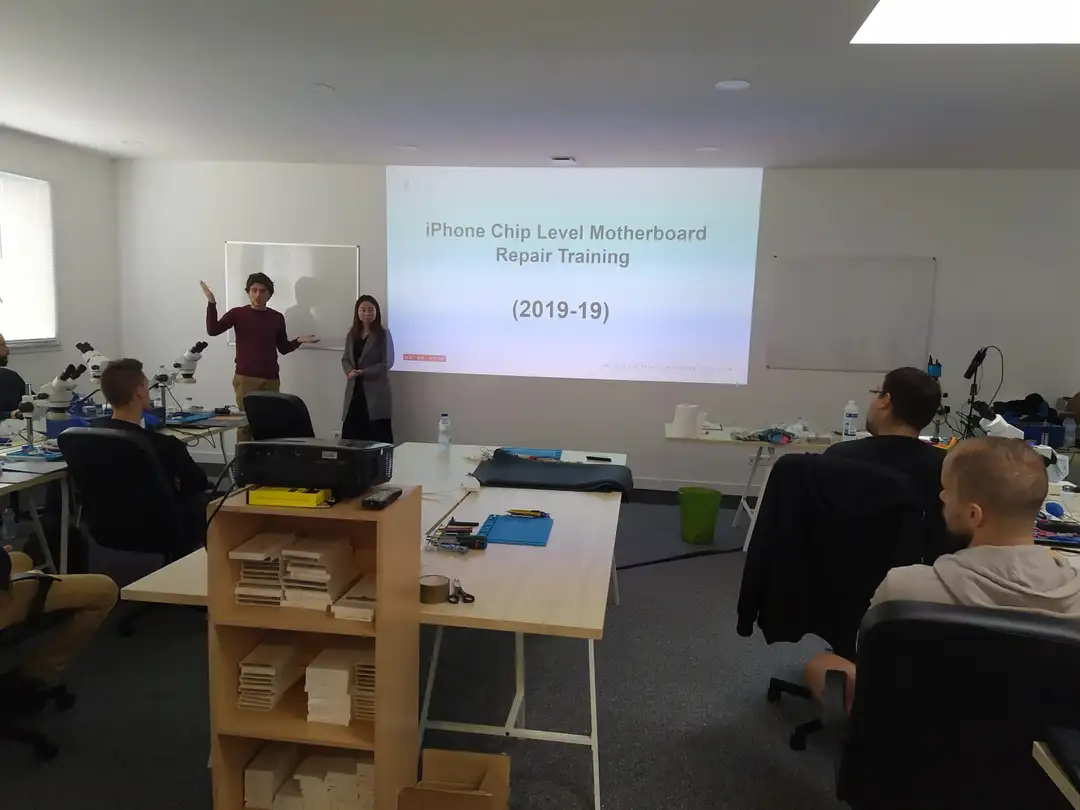
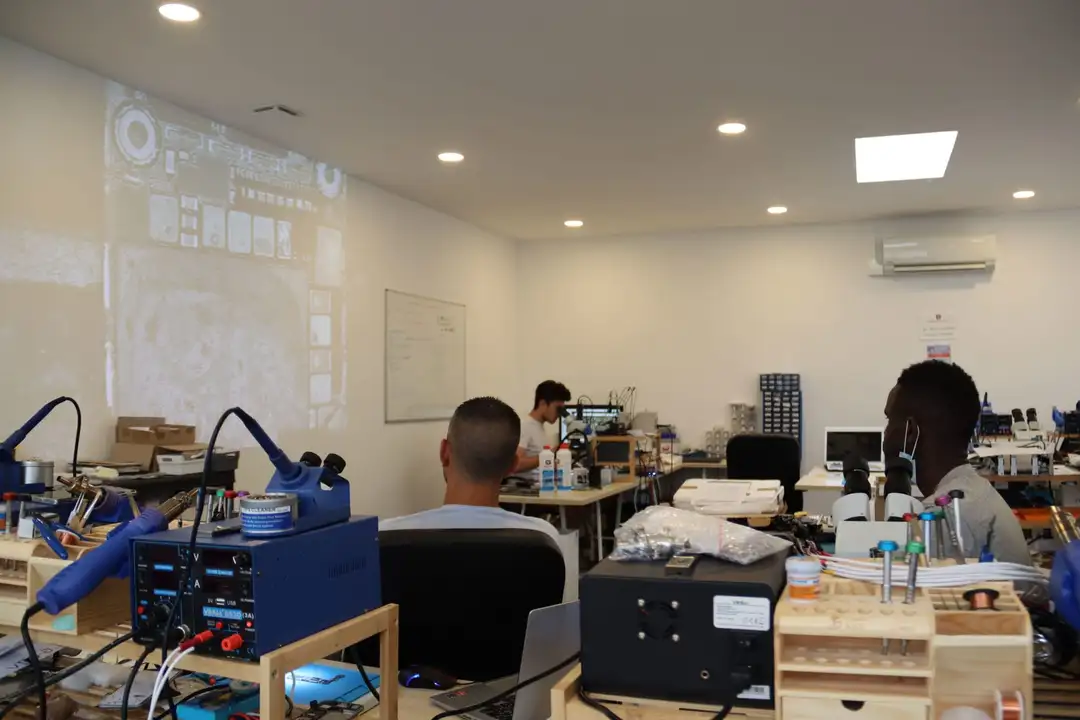
The programme is the same whatever the format. The 70 h format covers theory and practice over two weeks in the workshop. The 35 h blended course asks you to follow the theory part online on our Skool platform (about two months, at your own pace) and to pass the quiz before the week in the workshop, which is then devoted to practice under the binocular microscope and to preparing for the final assessment. You choose the format that suits your pace, your existing knowledge and your budget.
With USB-C becoming universal, 5G rolling out and right-to-repair policies on the rise, knowing how to work at motherboard level is a major competitive advantage for repair shops, refurbishment centres and independents. The practical cases are updated regularly with the recurring faults of recent smartphones (iPhone X to 15 series).
Programme
The programme, day by day.
Same programme in both formats. The blended course starts with an online theory part on Skool, validated by a quiz, then a week of practice in the workshop.
Programme last updated: November 2026.
70 h course: 10 days in the workshop
Monday to Friday for two weeks, 7 h a day (9:00-12:00 and 13:00-17:00). Theory on iPhone schematics in the morning, diagnosis and practice under the microscope in the afternoon.
Day 1iPhone start-up schematics, short-circuit detection, first SMD components.
Morning
- Round table and presentation of the programme
- Challenges of motherboard repair and how the iPhone motherboard works overall
- Theory on basic components: resistor, capacitor
- Course on the iPhone start-up schematic
- Introduction to diagnostic and short-circuit detection methods
- Safety instructions, PPE, ESD and workstation organisation
Afternoon
- Diagnosis of start-up circuits and short circuits
- Presentation of repair tools, removal of shielding
- Removal and replacement of SMD components (surface-mounted components)
- Practice and first guided practical cases on training boards
Day 2Display, backlight, touch, multimeter, iBridge and BGA.
Morning
- Recap and fixing the faults from the day before
- Course on iPhone display, backlight and touch schematics
- Universal diagnostic method
- Multimeter in diode, resistance and voltage modes, use of the iBridge
Afternoon
- Diagnosis of display, backlight and touch circuits
- Diagnosis of poorly soldered components
- Removal, replacement, reballing and reflow of BGA (chips)
- Practice of the methods taught
Day 3Charging, USB and USB-C, repair software, micrometric jumper wire repair.
Morning
- Course on charging management and USB communication schematics
- Advanced software: 3uTools, Refox, XinZhiZao
- iTunes errors and USB-C specifics (voltages, power negotiation, short-circuit risks)
Afternoon
- Diagnosis of charging and USB circuits
- Micrometric jumper wire repair to restore a broken connection
- Repair of a torn-off pad under a BGA
- Practical cases of charging faults: torn-off connectors, short circuits, oxidation
Day 4Cameras, flash, Wi-Fi, Bluetooth and connector replacement.
Morning
- Course on front and rear camera, flash LED, Wi-Fi and Bluetooth schematics
Afternoon
- Diagnosis of camera, flash, Wi-Fi and Bluetooth circuits
- Replacement of FPC, Micro-USB and USB-C connectors
- Deepening of soft soldering
- Analysis of Wi-Fi and Bluetooth network faults on recent motherboards
Day 5Audio, Touch ID, NAND, Purple mode and DCSD cable.
Morning
- Course on audio management, microphone, amplification and speaker schematics
- Touch ID schematics and diagnostic methods
Afternoon
- Diagnosis of audio circuits
- Removal of the NAND Flash and advanced use of iPhone NAND programmers (JC range)
- Extending iPhone storage and repairing NAND-related errors
- Purple mode and DCSD cable
- Discussion of the legal and ethical issues of storage modification and user data management
Day 6Baseband 2G to 5G, iPhone X, XS and XS Max, Android network faults.
Morning
- Course on Baseband schematics and the management of 2G, 3G, 4G and 5G communications
- Baseband diagnostic method
Afternoon
- Diagnosis of Baseband circuits
- New elements and recurring problems on iPhone X, XS and XS Max
- Separation and reballing of an iPhone X, XS and XS Max motherboard, jumper wire repair
- Case study: network faults on Android (IMEI loss, no service)
Day 7Face ID, sensor repair, iPhone 11 and recent developments.
Morning
- Course on Face ID schematics
- Sensor repair methods linked to Face ID
- Practice of the methods taught
Afternoon
- Recurring problems on iPhone 11, 11 Pro and 11 Pro Max
- Separation and reballing of an iPhone 11 motherboard, jumper wire repair
- Face ID and Dynamic Island developments in recent series (iPhone 13 to 15 Pro) and what they mean for repair
Day 8Face ID diagnosis and repair, iPhone 12 and real practical cases.
Morning
- Face ID diagnosis
- Face ID repair
- Practice of the methods taught
Afternoon
- New elements and recurring problems on iPhone 12, 12 mini, 12 Pro and 12 Pro Max
- Separation and reballing of an iPhone 12 motherboard, jumper wire repair
- Practical cases: you choose real faults to work on with the instructor’s support
Day 9General revision and mock final assessment.
Morning
- General recap of the theory for assessment preparation
- Practice of the methods to revise
Afternoon
- General recap of the practical elements
- Practice of the methods to revise
- Reuse, repairability and electronic waste management (WEEE)
- Accessibility: welcoming a customer with a disability and checking accessibility functions after an intervention
- Mock assessment before the panel: role play, time management, structuring the oral explanation
Day 10Final assessment before the panel, end-of-course ceremony and post-course resources.
Morning
- Trainees’ final assessment before the panel
- Revision for trainees waiting and free practice for those who have finished
Afternoon
- Final assessment (continued) and end-of-course ceremony
- General conclusion and farewell drink
- Post-course resources: alumni community, TRA Job, The Repair Academy Store, practice tips and technical watch
35 h blended course: online part then 5 days in the workshop
The online theory part on our Skool platform (about two months, at your own pace) and the quiz must be completed before the week in the workshop (registration open until 60 days before the start). Then 5 days of practice, 7 h a day (9:30-13:00 and 14:00-17:30).
Day 1Shielding, 0402 to 01005 capacitors, connectors, multimeter and short circuits.
Morning
- Presentation of the course and its programme
- Removal of shielding
- Replacement of 0402 to 01005 capacitors
- Reminder of safety instructions, PPE, ESD and workstation organisation
Afternoon
- Replacement of FPC, through-hole and surface-mount USB-C connectors, Micro-USB and HDMI
- Use of a multimeter and interpretation of the results for a precise diagnosis
- Fault simulations to locate a short circuit on the main lines
Day 2BGA, post-PMU short circuit, jumper wire repair with pre-cut pad, iBridge.
Morning
- Recap of the day before
- Removal and replacement of BGA (chips)
- Fault simulations: short circuit on the post-PMU lines
Afternoon
- Micrometric jumper wire repair with a pre-cut pad
- Fault simulations to locate an open line
- Use of an iBridge to check diode values
Day 3Jumper wire repair with 0.02 mm wire, complex faults, motherboard reballing.
Morning
- Recap of the day before
- Micrometric jumper wire repair with 0.02 mm wire
- Complex fault simulations: open lines or short circuits
Afternoon
- Separation and reballing of an iPhone 12 series and newer motherboard (217 °C solder)
- Separation and reballing of an iPhone 11 and older motherboard (138 °C solder)
Day 4NAND, assessment revision, final multiple-choice test and real practical cases.
Morning
- Recap of the day before
- Removal and replacement of a NAND
- Reuse, repairability and electronic waste management (WEEE)
- Accessibility: welcoming a customer with a disability and checking accessibility functions after an intervention
- General recap of the theory for assessment preparation
- Practice of the methods to revise
Afternoon
- Final multiple-choice test (20 questions, 20 minutes)
- Practical cases: you choose real faults to work on with the instructor’s support
Day 5Final assessment before the panel, end-of-course ceremony and post-course resources.
Morning
- Recap of the day before and trainees’ final assessment before the panel
- Revision for trainees waiting and free practice for those who have finished
Afternoon
- Final assessment (continued), end-of-course ceremony
- General conclusion and farewell drink
- Post-course resources: Skool, alumni community, TRA Job, The Repair Academy Store, practice tips and technical watch
Assessment
How your skills are assessed.
Before registration, the “Which course is right for me?” questionnaire and a review of your CV validate your project and prerequisites. A placement quiz, sent 7 days before the course (or an entry multiple-choice test after the online part for the blended course), measures your level. The final practical assessment takes place at the end of the course, in 3 parts: a 20-question multiple-choice test in 20 minutes (20% of the mark), a 1-hour practical case of diagnosis and repair on a real motherboard in front of the panel (60%), and a 10-minute practical case on professional software (20%). The panel brings together a training professional who did not teach you and an external industry professional. The skills grid used for the assessment is shared with you.
- Rigorously follow a diagnostic procedure
- Detect whether a device has a software, hardware or electrical fault
- Read and explain a block diagram
- Use the software dedicated to repair: 3uTools, schematic software
- Identify components on a motherboard and on the block, electrical and layout diagrams
- Analyse software errors to repair the device: restore error
- Judge whether an electronic board has a history: already worked on, exceptional heating, oxidation, bending, physical damage, carbonisation
- Interpret multimeter values to diagnose a fault
- Know how to use the tools of electronic board repair
- Practise manual soft soldering techniques: replacing SMD and BGA, jumper wire repair, connectors, full reballing of a two-part motherboard, jumper wire repair and BGA reballing on flex cables, repair in the inner layers
- Apply electrical safety rules, ESD protection and the management of risks from soldering fumes and chemicals
- Document an intervention (repair sheet, photos, measurement readings)
- Carry out the necessary reprogramming of memory and paired components, securing the data handled
- Place diagnosis and repair within a reuse approach and sort the replaced components according to electronic waste obligations
- Adapt communication to a customer with a disability and check the device’s accessibility functions after an intervention
Schedule
Upcoming sessions.
Pick a date: the registration form fills itself in. Scheduled sessions in Toulouse and Paris are taught in French; English-language sessions are coming. Dates may change. Blended track: registration closes 60 days before the start, to leave time for the online theory part.
Practical information
Audience, duration, price and accessibility.
Audience and prerequisites
- Who it is forRepairers, independents, shop managers, refurbishment technicians, career changers
- Prerequisites6 months of professional smartphone repair experience, notably replacing spare parts (CV)
- AlsoPlacement questionnaire, Windows 10 or 11 basics, French level B1 minimum
- BlendedOnline theory part completed and quiz passed
- Beginner? Start with the smartphone repair training
Duration and organisation
- 70 h10 days, 9:00-12:00 and 13:00-17:00
- Blended 35 h5 days, 9:30-13:00 and 14:00-17:30
- Group size12 trainees maximum
- Supervision1 instructor for 6 in the workshop
Price
- 70 h€4,500
- Blended 35 h€2,250
- IncludedTraining equipment and a booklet of nearly 100 pages
- Funding may be possible depending on your status (see below)
What to bring
- ComputerLaptop running Windows 10 minimum, with 3uTools and XinZhiZao
- MotherboardsAt least 5 broken iPhone boards, and screwdrivers
- ProvidedHot air station, multimeter, soldering iron, binocular microscope, fume extractor, ESD mat
Accessibility
- Reduced mobilityPlease tell us one month ahead
- Other needsContact us as early as possible
- Disability officerDorian Canit
- Training officerAlexandre Isaac
Location and next steps
- Toulouse2 rue Paul Verlaine, 31200
- ParisAddress given at registration
- TravelGuide with recommended hotels
- AfterwardsAlumni, TRA Job (job matching), The Repair Academy Store
Funding
- French public funding (CPF, OPCO, France Travail) is only available to residents of France.
- Your employer or your national training scheme may cover the cost: ask us for the documents you need (quote, programme, attendance certificate).
- Payment in several instalments may be possible: ask us.
FAQ
Your questions.
Our scheduled sessions in Toulouse and Paris are taught in French. English-language sessions are being scheduled: register your interest and we will tell you the dates as soon as they are set. If you are comfortable with French, you can join any scheduled session.
Both formats follow the same programme. The 70 h course runs over 10 days in the workshop. The blended course starts with an online theory part on Skool (about two months, at your own pace) and a quiz to pass, then a 5-day week in the workshop, strongly practice-oriented, for €2,250 instead of €4,500.
Registration for the blended course closes 60 days before the start of the session, because the online theory part and the quiz must be completed before the week in the workshop. The deadline is shown for each session in the schedule.
Yes, you need at least 6 months of professional smartphone repair experience, notably replacing spare parts, shown with a CV. The course is not open to beginners, who can start with the smartphone repair training.
At the end of the course, in 3 parts: a 20-question multiple-choice test in 20 minutes (20% of the mark), then in front of the panel a 1-hour practical case of diagnosis and repair on a real motherboard (60%) and a 10-minute practical case on professional software (20%). The panel brings together a training professional who did not teach you and a professional from outside the school. A skills grid is shared with you in advance, and adjustments are provided for candidates with disabilities.
iPhone motherboards from the X to 15 series: start-up, short circuit, charging and USB-C, display, cameras, audio, Touch ID, Face ID, Baseband and network, NAND. Network faults on Android devices (IMEI loss, no service) are also studied, and the practical cases are updated with the most frequent faults.
Replacement of SMD components (0402 to 01005), BGA chips and NAND, replacement of FPC, USB-C and Micro-USB connectors, micrometric jumper wire repair (0.02 mm wire), repair of a torn-off pad under a BGA, separation and reballing of iPhone motherboards, repair in the inner layers.
A laptop running Windows 10 minimum with 3uTools and XinZhiZao installed, at least 5 broken iPhone motherboards and screwdrivers. All training equipment is provided: hot air station, multimeter, soldering iron, binocular microscope, fume extractor and ESD mat.
Sessions take place in Toulouse (2 rue Paul Verlaine, 31200) and, for some dates, in Paris. The location is shown for each session in the schedule; the Paris address is given at registration. You receive a travel guide with recommended hotels.
The workshop is limited to 12 trainees, with one instructor for every 6 trainees in the workshop. An individual review of about 15 minutes is offered mid-course to take stock of what you have learned.
French public funding is only available to residents of France. Your employer or your national training scheme may cover the cost, and payment in several instalments may be possible. Contact us to look at your situation.
You get access to post-course resources: the alumni community, TRA Job (a platform connecting you with partner shops, refurbishment centres and manufacturers) and The Repair Academy Store for equipment.
Book your seat.
Register in a few minutes. An instructor calls you back within 24 h to check your project.